

The History of Broad Plain and the Soap Factory
It is commonly known that the Broad Plain complex was originally a soap factory long before Gardiner & Sons occupied the site in the 1950s. What is less widely known is just how rich and significant the history of this iconic Bristol building really is.
Discover the fascinating story of the Fripp Soap Factory and its transformation over more than two centuries.
The Fripp Soap Factory
In 1745, the soap manufacturing company Samuel Fripp & Co. was established by Samuel Fripp and Henry Davis. Over the following decades, the company underwent several name changes as new partners joined and others departed.
In 1771, the business became Fry, Fripp & Co. following the addition of Joseph Farrell, John Vaughn, Joseph Fry and William Jones. This period marked the firm’s growing importance within Bristol’s manufacturing industry.
It was not until 1783 that the company acquired the Broad Plain complex in St Philips. After the death of Joseph Fry in 1787, and with three of the five partners being members of the Fripp family, the name reverted to Samuel Fripp & Co.
Further changes followed:
William & James Fripp & Co. (1810–1819)
William Fripp & Co. (1819–1827)
Fripp & Co. from 1827 onwards
Bristol’s Soap Industry Boom
During the 1820s–1840s, Bristol was the third largest soap manufacturing centre in Britain. By 1825, Fripp & Co. was producing half of Bristol’s soap, highlighting the scale and success of the operation.
The business remained family-owned until 1841, when it merged with T. Thomas & C. J. Thomas. The Thomas family, originally from Llangadog in Carmarthenshire, had established their own soap manufacturing business in Castle Street, Bristol.
A Soapy Partnership
The Thomas soap business was founded in 1823 by Stephen Thomas and his son-in-law John Jones as Jones, Thomas & Thomas, later renamed T. Thomas & C. J. Thomas in 1831 when Stephen’s two sons took over.
It was Edward Bowles Fripp Sr. who invited the Thomas brothers to form a partnership with his son, E. B. Fripp Jr., at Broad Plain. This created Thomas, Fripp & Thomas.
In 1855, when E. B. Fripp Jr. retired, the company became known as Christopher Thomas & Bros., made up of Christopher, Thomas, Herbert and Charles Thomas. After the deaths of Thomas in 1872 and Christopher in 1877, the youngest brother, Charles Thomas, emerged as the leading figure in the business.
The ‘Golden Era’ of Soap
The years 1856–1889 are often described as the Golden Era of soap manufacturing, following the abolition of soap duty in 1853. This removal of tax dramatically increased demand and profitability across the industry.
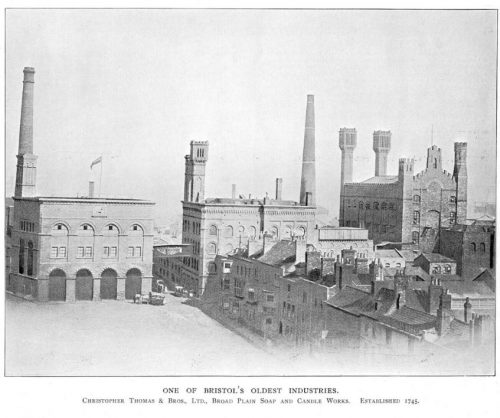
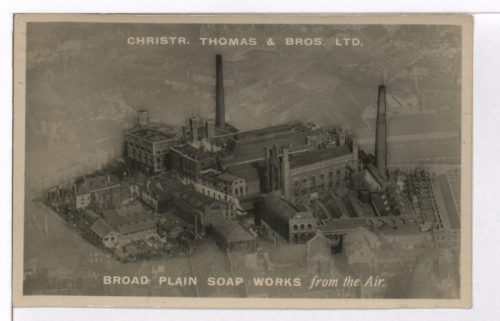
Between 1865 and 1867, the Broad Plain site underwent major development. Architect William Bruce Gingell designed the now-iconic building in 1865, drawing inspiration from a trip to Italy. The result was a striking example of Bristol Byzantine architecture.
One contemporary observer remarked:
“In viewing the premises of the manufactury, one is struck with the unique chimney towering high above one of the principal additions to the other buildings. This is said to be an exact copy of the Tower of Palazzo Vecchio, the great Town Hall of Florence.”
By 1881–82, the entire works were rebuilt under Charles Thomas, who carefully preserved the Italianate style.
Puritan Soap and Changing Fortunes
Unfortunately, the Golden Era did not last. By 1886, profits were declining, and some family members wished to release their capital. The company became a private limited company in 1889, entered voluntary liquidation in 1897, and was subsequently incorporated.
Facing competition from the Lever Brothers and their hugely successful Sunlight Soap, the company launched an olive oil-based alternative called Puritan Soap in 1898.
In the early 20th century, Herbert Russell Thomas, Christopher’s son, modernised the factory by converting it from steam power to electricity in an effort to keep the business competitive.
A Devastating Fire and the Final Years
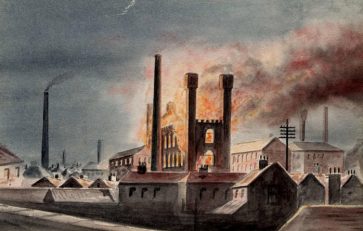
Tragedy struck in 1902, when a devastating fire destroyed much of the decorative brickwork and led to the reduction of the iconic chimneys. Despite this setback, the factory continued operating.
By 1912, Lever Brothers had absorbed Christopher Thomas & Bros. Ltd. and its brand. During the First World War, the factory shifted production from soap to dynamite glycerine for military explosives.
The Broad Plain works continued to produce Puritan Soap until 1953, before announcing its closure. Soap production finally ceased in 1954, bringing more than 200 years of manufacturing history at Broad Plain to an end.
Bibliography
John Penny, Bristol at Work (DB Publishing, 2005), pp. 74–79.
Featured Image:
Christopher Thomas & Bros. Ltd. Puritan Soap, 1951. Courtesy of Bristol Records Office.


